Our Custom Software Development Process
At NGBSS, we follow a structured, transparent and highly predictable custom software development process designed to deliver long-term value, technical reliability and measurable business impact. Every stage is carefully crafted to reduce risks, increase development speed and ensure that your software solution meets real operational requirements.
Our methodology combines industry best practices with extensive hands-on experience in enterprise-grade architectures, cloud systems, DevOps, QA automation and end-to-end digital product development. The result is a process that offers clarity, stability and scalability for companies that need high-performance custom applications.
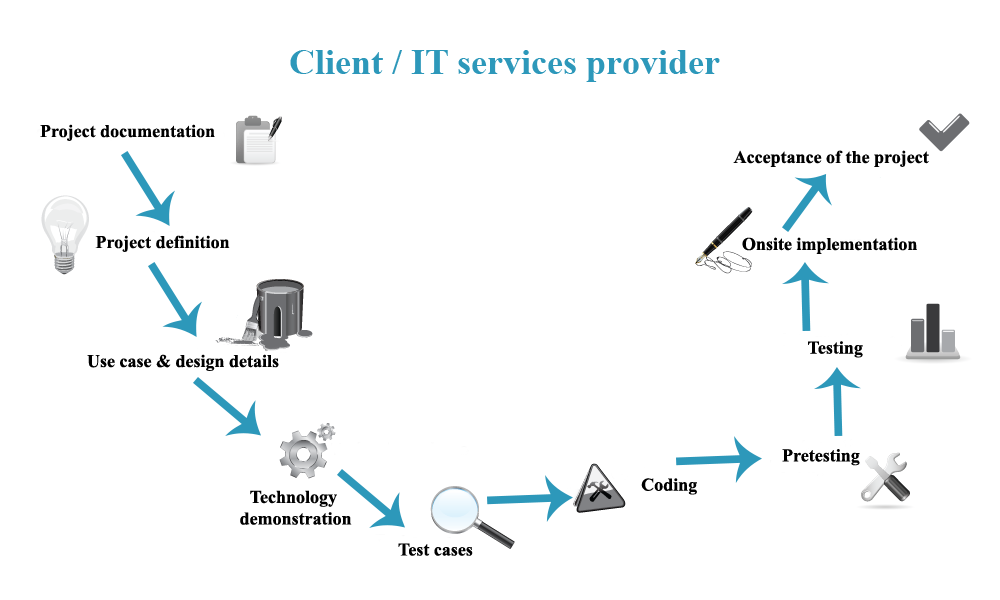
Below you will find the exact 10 steps that appear in your original visual workflow, preserved 1:1 in the same order.
1. Project Documentation
Documentation is the foundation of any successful software project. In this phase, we gather all the essential business, operational and technical information needed to build a solution that fits your company’s real needs.
We begin with stakeholder interviews, analysis of current workflows and identification of pain points. Our goal is to understand how your business operates today and how the new software should improve efficiency, reduce costs or automate processes.
During this stage, we document:
- business goals and project objectives;
- user roles and operational workflows;
- existing systems and integrations;
- technical constraints and dependencies;
- functional requirements and expected outcomes;
- KPIs for measuring success.
This documentation becomes the blueprint for the entire project. For companies requiring deeper digital strategy, we can integrate insights from our software development consulting services.
2. Project Definition
After collecting all business and technical details, we define the project scope clearly and objectively. This phase transforms the raw documentation into a structured, actionable technical plan.
The Project Definition includes:
- Functional Requirements Document (FRD);
- Technical Specifications (SRS);
- Acceptance criteria for each feature;
- Preliminary software architecture;
- resource allocation and timeline estimation.
This eliminates ambiguity and ensures that all stakeholders share the same understanding of what will be delivered. If your project requires complex data structures, we integrate expertise from database programming services.
3. Use Cases & Design Details
Use cases describe the real interactions users will have with the software. They help us ensure the application is intuitive, efficient and aligned with operational requirements.
Based on the use cases, we construct UX flows, wireframes, UI mockups and early interface prototypes. These assets help visualize the final product long before coding begins, allowing clients to make informed decisions about the user experience.
Deliverables in this stage include:
- user stories and flows;
- UX diagrams;
- UI wireframes or prototypes;
- logic definitions for each module;
- workflow interactions and validation rules.
For applications with complex interfaces, we integrate additional expertise from our web development services.
4. Technology Demonstration
The Technology Demo validates that the chosen technical approach is feasible, efficient and aligned with the project’s long-term goals. This step significantly reduces risks by confirming the direction before full development begins.
Examples of technology demonstrations include:
- prototype APIs and backend endpoints;
- cloud infrastructure proof-of-concept;
- performance testing for critical modules;
- UI/UX functional previews;
- integration feasibility tests.
Clients gain clarity and confidence by seeing real functionality early in the process.
5. Test Cases (Test Plan)
Before development starts, we create a comprehensive Test Plan that outlines how every feature will be validated. This ensures complete coverage during QA and prevents missing edge cases later in the project.
The Test Plan includes:
- functional test scenarios;
- integration test flows;
- performance and stress cases;
- security validation steps;
- usability testing guidelines.
This approach guarantees that every feature developed during coding will be tested under real operational conditions. For long-term applications, we also provide dedicated application maintenance services.
6. Coding
In this stage, our development team begins building the application using the approved architecture and technologies. Coding is performed in iterative cycles (sprints), ensuring continuous progress and transparency at every milestone.
We follow best practices such as:
- clean, modular code;
- scalable architecture patterns;
- REST or GraphQL API development;
- Git versioning and code reviews;
- CI/CD pipelines for automated deployments.
Depending on the solution, this stage may involve collaboration with teams specializing in software development and custom software development.
7. Internal Pre-Testing
Before the software reaches the QA team, developers perform internal pre-testing to validate stability, functional logic and module interactions. This step reduces the number of issues found later and speeds up the QA cycle.
Pre-testing includes:
- unit testing;
- interface validations;
- logic consistency checks;
- initial data flow testing.
8. Full Testing
In this phase, the QA team performs complete testing of the application across all modules, flows and integrations. This ensures the final product meets quality standards and functions flawlessly under real-world conditions.
We test:
- full feature functionality;
- cross-module interactions;
- browser and device compatibility;
- performance under load;
- security vulnerabilities;
- data integrity and error handling.
All issues are documented, fixed and revalidated before release.
9. Onsite Deployment / Launch
Once testing is complete, we deploy the application to your production environment or cloud infrastructure. We handle every detail: configurations, data migration, backups, monitoring and validation.
For complex, multi-system deployments, we may integrate expertise from our software migration services.
10. Project Acceptance
In the final stage, the client reviews and validates the delivered application. Once confirmed, we provide full documentation, training, user manuals and post-launch support options.
Clients who require continuous evolution and improvement of their software can extend collaboration through our IT outsourcing services.
Do you want a predictable, transparent and enterprise-grade software development process?
Contact us for a project analysis and tailored technical proposal.